
I resisted the urge to turn around and smile.
But I couldn’t help smiling to myself as the Uzbek immigration officer moved a metal barrier aside and ushered me past the dozens of Tajik women who had tried so hard to keep me from the front of the immigration line.
And I smiled again when the officer didn’t just lead me to the end of the lengthy customs line, but instructed me to go directly to the front. Three hours after leaving my hotel in Khujand, Tajikistan, the end of my journey was finally in sight.
As I so often did in Tajikistan, I awoke that morning when the sun rose – around 5:00 a.m. – and lay awake in my hotel room. I was in no rush to get up even though it was my last day in Tajikistan and the day I would finally move on to Uzbekistan.
I was wishing I could magically transport myself to Tashkent rather than navigate the border crossing between Tajikistan and Uzbekistan.
The two countries don’t have the best relationship and I heard that Uzbek officials in particular could be difficult. I also had no clue how I would actually get to the border. Although Lonely Planet said a taxi from Khujand should be $15, drivers were quoting me 200 Tajik somoni – the equivalent of $40 – and I just didn’t want to pay that much (I also didn’t have that much in somoni left).
I decided instead to try to take a marshrutka to a town called Buston, from where I read I would be able to get a much cheaper shared taxi. However, after waiting for 20 minutes in the scorching morning sun with no marshrutka in sight, I tried one last time to hail a taxi. Once again, the driver quoted me 200 somoni. But this time when I declined, he offered to take me to a bus station on the edge of town for 25 somoni, from where I could take a shared taxi. Yes!
By 8:30, I was sitting in the back seat of a taxi with a friendly Tajik woman – for a fare of just 60 somoni. The ride was much longer than I expected, but the time passed quickly as I chatted up my seatmate and learned about her visit to see her parents in Uzbekistan. The family was separated when the Soviet Union disintegrated and now they require visas to visit each other – something they can do only once a year for ten days at a time. By the time we reached the border, she had shown me pictures of her kids and took a picture of us together on her cell phone.
I hoped my new friend might help guide me through the immigration process entering Uzbekistan, but she was held back as we departed Tajikistan.
Leaving Tajikistan was the easy part.
As I approached the immigration and customs building on the Uzbekistan side, my heart sank. I entered to find a throng of people lined up in front of a window with just one immigration officer processing the whole crowd. Around the edges of the small room people hovered over customs forms, carefully filling in the blanks.
After completing two copies of the form, I got in what some people might call a line. While I read on another blog about friendly Tajiks knowing how to queue so well, my experience was just the opposite. I was surrounded by Tajik women who seemed to think it was their mission to make sure I never made it to the front. After an hour of getting bumped to the side by pushy women waiting to shove their passports over to the single officer on duty, I had enough. As I finally neared the front of the line only to have yet another woman try to slide her passport past mine, I scolded her in Russian that I was there before her.
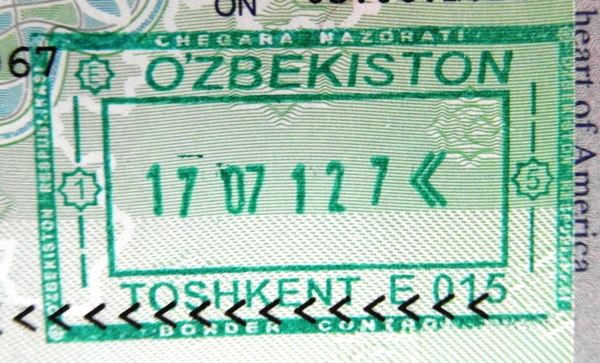
I don’t know if the officer behind the window heard me or if he just finally noticed the tallest, blondest woman in the room, but he pushed the other Tajik passport back and asked me for mine. Within minutes, he stamped me into Uzbekistan and led me past the throng of people waiting behind the metal fence.
But I still had to clear customs.
Despite my bump to the front of the line, I stood nervously as I waited for a scowling officer to review my forms, making marks here and there and then circling the section in which I declared how much cash I was carrying. Uzbek officials are known to be notoriously strict about how much money people bring in and out of the country and I was told to very carefully declare all that I have. Knowing that working ATMs may be hard to find in Uzbekistan, I stocked up on US dollars in advance and came in carrying over $1400 and 80,000 Uzbek soms – about $40 worth that I changed at the border. I didn’t think twice about such an amount, but as I stood waiting to go through immigration I saw a sign that seemed to indicate that you couldn’t bring in more than $1000 so I was doubly nervous when I got to customs.
I had also heard that prickly guards might decide to search my belongings or ask me all sorts of questions, but luckily no one was feeling difficult and they let me threw with no hassles at all.
By 11:00 a.m., I had settled into the back of a taxi with a cold bottle of water for the ninety minute ride to Tashkent.
The hardest part of my journey was over and all I had left to do was enjoy the ride.
