

I want to love Armenia, I really do.
The country’s history is fascinating, dating back not centuries but millennia. It considers itself the cradle of Christianity, having adopted the religion 1700 years ago. The mountain landscapes are breathtaking and on a clear day in Yerevan you can find yourself staring directly at Mt. Ararat. The people are some of the friendliest I have encountered.
On paper, my volunteer placement is exactly what I wanted and my host family could not be more welcoming. My host “mom” spoils me with a home-cooked breakfast that seems to change every day and shows great patience as I try to speak Russian (she speaks no English). I have even found Western products in Yerevan that I have been missing for months, like Skippy peanut butter and Neutrogena.
But instead of basking in the glow of an amazing experience, feelings of intimidation and insecurity keep creeping in.
For the first time, I am experiencing true “language shock.”
Arriving in Armenia made me realize how comfortable I had become speaking and reading Russian. Suddenly, I am in a situation where not only do I not understand the language, I can’t even read the alphabet! Armenian is like nothing else on earth and while I am taking Armenian lessons twice a week, my teacher isn’t even attempting to teach me to read. It is just too difficult. Likewise, words in Armenian contain sounds that my mouth doesn’t even know how to make. My teacher says a word, I repeat it, she shakes her head and says it again, I repeat again…and on and on until I think she just tires of correcting me.
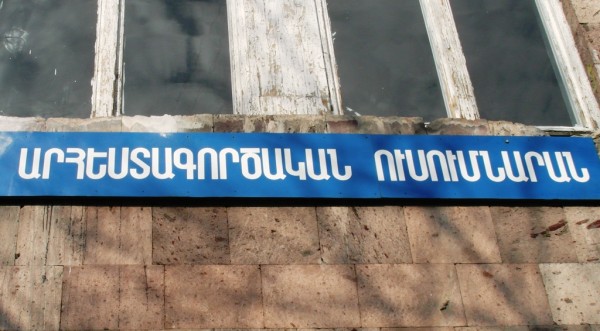
Not knowing Armenian makes me feel helpless. I can’t read the signs on the marshrutkas (mini-buses) to see where they go, making it harder to get around. I can’t read the menus in most fast food restaurants, leaving me to eat half my meals at KFC because I know how to order chicken kebabs, fries and coleslaw there (the girl at KFC actually has my order memorized, which is a little scary). People keep telling me that everyone at least understands Russian, but my initial attempts to speak Russian were either ignored or met with scowls. When I try to use the few words I know in Armenian, no one seems to understand because my pronunciation is off.
Everyone questions why I am here.
Everyone I have met in Yerevan asks me the same thing right off the bat: “why did you come to Armenia?” They seem suspicious of me, asking in a way that immediately puts me on the defensive, trying to explain myself, hoping I come up with a satisfactory answer. No one seems to understand why a blonde American with no Armenian roots would want to visit this country.
This questioning is new to me. No one in Estonia questioned why I would visit Estonia and no Lithuanians seemed to find it odd that I would spend two weeks in Vilnius. While many Russians thought my desire to do the Trans-Siberian was bizarre, no one thought twice about my reasons for visiting St. Petersburg or Moscow. But for some reason in Armenia, people seem to think I am incredibly weird for wanting to come here. Even the guy who sold me my visa at the border raised his eyebrows at the fact that I requested a visa for longer than the standard 21 days.
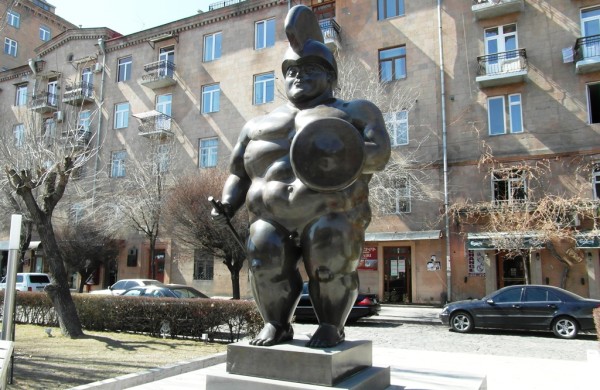
I feel like I just don’t fit in.
Until now, I have been able to bend in fairly well. Eastern Europe was full of fair-skinned blondes and with my coat and boots purchased in Russia and my hat and scarf in Poland, I looked quite European. In Armenia, I stand out like a sore thumb – not only as stares follow me down the street in Yerevan but within the group of other volunteers as well.
Let’s take a step back. I am in Yerevan volunteering through the Armenian Volunteer Corps (AVC). The group appealed to me because they are based locally and place volunteers based in part on their professional backgrounds, skills and interests. While AVC accepts volunteers of all ages and ethnicities, its sister organization, Birthright Armenia, focuses on bringing ethnic Armenians ages 20-32 who grew up outside the country back to volunteer. The two groups share offices and the staffs seem interchangeable. Birthright offers excursions and language classes in which AVC volunteers are welcome to participate. To be honest, I didn’t give the existence of two different organizations (or their overlap) much thought prior to arriving.
I didn’t anticipate that I would be the only non-ethnic Armenian volunteer.
I feel like the other volunteers have connected with each other in ways that I just cannot. Some have already been in Armenia for months and have forged strong friendships; others seemed to click immediately upon arrival. More than anything, they share a common background, a common heritage, a common language. While visiting Armenia is an interesting stop for me on my year-long journey, it means so much more to them. I would say it is like me visiting Norway or Germany, but Armenia for them is clearly more powerful. My ancestors didn’t flee those countries due to war or genocide. I didn’t grow up hearing stories from my parents about the homeland or speaking Norwegian or attending German school. They are experiencing things in Armenia in a way I can never fully understand.
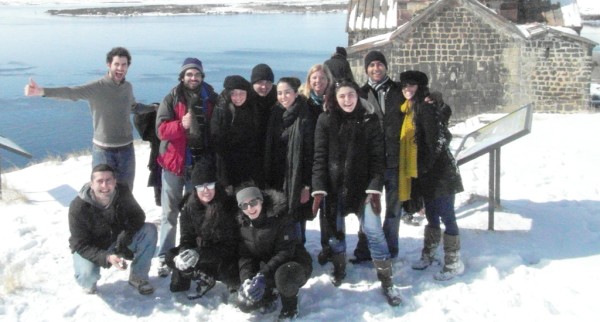
I also didn’t expect that I would be the only one over 30.
Heck, I may be the only one over 25. Either way, I have had a hard time really relating to, or connecting with, the other volunteers. I feel like we are in such different places in our lives and I struggle to find things in common. Most of the others recently finished college or graduate school and are taking time to volunteer and explore their roots before moving on with their careers. They are doing what I wish I had done ten years ago and I envy them that they’re doing it now.
Don’t get me wrong, everyone has been incredibly friendly.
Several have even gone out of their way to make me feel welcome. But overall, while I don’t think I’ve been purposefully excluded, I feel like I’m not totally included either. And while I love meeting people one-on-one ,when it comes to breaking into a group – especially a close-knit group full of inside jokes and shared experiences – my insecurities take over and I tend to shut down a bit. It’s not them, it’s me.
♦♦♦♦♦♦♦♦♦♦♦♦♦♦♦♦♦♦♦♦♦♦
I wrote everything above on my 10th day in Yerevan.
I was frustrated and feeling lonely and starting to count down the days until April 14, when I am scheduled to move on. But now, with a few more days under my belt, I realize what I really need is more time.
Every day gets better. I have now had several decent conversations in Russian and I am confident I can explain to taxi drivers how to get to my apartment. The bleached blonde woman with gold teeth at the shop across the street greets me warmly in Russian every time she sees me. In the city center, more store clerks speak English than I initially realized (or expected). Sure, I’m not communicating in Armenian as I hoped, but I am communicating.
At the same time, I am starting to at least recognize some words in Armenian and I know if I had more time, it would eventually get easier. I have spent more time with my fellow volunteers and, while I still feel a bit of a gap, I am starting to feel more comfortable. If I had more time, I could get to know them better, understand their culture more, and develop closer friendships.
And if I had more time, I would be able to see more of Yerevan and the surrounding area. Between volunteering Monday through Friday, Armenian class twice a week and excursions to other parts of the country on the weekends, I have had little see the major sights close to the city, like Echmiadzin, Garni and Geghard Monastery. I feel like I may miss a lot.
Now, rather than counting the days until I leave, I am wishing I had more time and trying to make the most of the next 3 weeks.
