
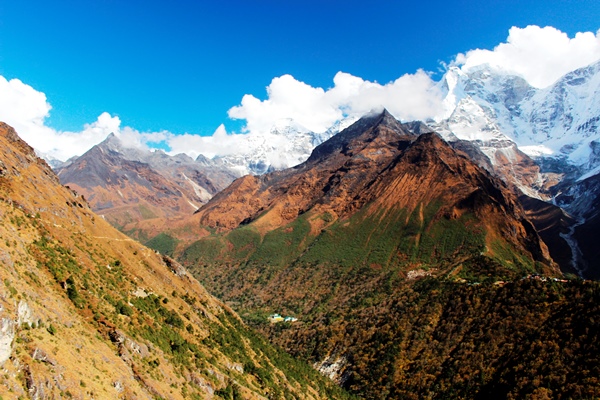
Hiking the Himalayas is like almost nothing else you have done before. Before my trip, my only frame of reference was hiking the Inca Trail to Machu Picchu four years earlier. Considering that was just a four day trip and only reached at altitude of 4400 meters, it really was no comparison. I did buy a Lonely Planet guide to hiking in the Nepal Himalayas beforehand and read a few blog posts, but nothing really prepared me for the whole experience. Here are a few things that I would tell any first-time trekker – specifically in the Everest region, although some of these could probably be applied to the Annapurna region as well.
You don’t have to go to Everest Base Camp. Before, during and after my trek, nearly everyone I met assumed I was in Nepal to hike to Everest Base Camp (EBC). I wasn’t. We instead took the path less traveled up to Gokyo Ri – a peak at about the same elevation as EBC and with a view straight across to Mount Everest. But really, we could have hiked to a number of different places. While going from Lukla to Namche Bazaar is almost a given, from Namche there are plenty of different options depending on how much time you have and how strenuous (or not) you want your trek to be. You could even just stay in Namche a few days and do some day hikes before heading back to Lukla.
Build in a cushion. Flights between Kathmandu and Lukla can often be delayed due to poor visibility – sometimes for days. Allow yourself extra time before and after your trek so you can adjust your trek as needed if you get delayed – and so you don’t risk missing your flight home out of Kathmandu at the end of your trip.
You don’t need a guide, but there are many benefits to having one. Talk to anyone who has hiked in the Everest Region and they will likely tell you that you do not need a guide. And it’s true, you can definitely hike in the region without one. But, I would argue that having a guide will enhance your overall experience. First, they can help you arrange accommodations. During the high season, the teahouses can fill up quickly with trekking groups. If you show up late in the day on your own, you may be out of luck. A guide may be able to call ahead to reserve you a room or, if you are using porters or dzokyos, the porters or dzokyo drivers can go ahead and get you a room. Moreover, many teahouses will only take hikers traveling with guides. Why? Because the guides help in the dining room – they take their hikers’ orders and deliver the food, making less work for the staff of the teahouse. Not to mention, they can serve as a translator between you and the owners, who don’t always speak much English. Our guide was also able to take us into monasteries that were otherwise closed, explained local traditions and beliefs to us and was a huge help when members of our group were struggling.
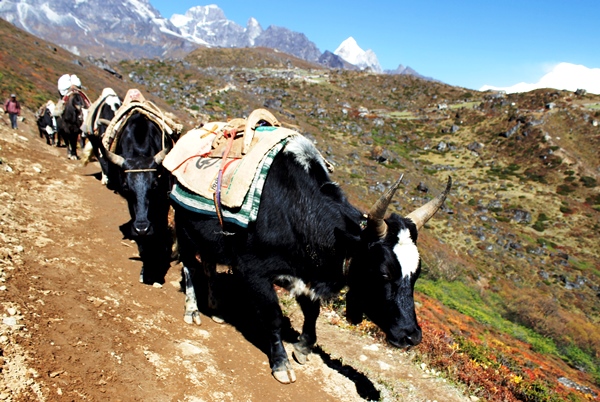
Don’t assume your backpack cover is waterproof. I learned this the hard way – my Eagle Creek backpack came with a built in “rain cover” which proved to be barely water resistant, much less waterproof. On the first major day of rain we experienced, my pack was soaked through – despite being covered with a tarp while on the back of a dzokyo! Luckily, I had anticipated that I might have some problems and had packed my electronics and clothing in plastic bags. Those stayed dry; everything else was dripping wet. Moral of the story: bring plastic bags. Lots of them.
You may not need to bring a sleeping bag. This may seem surprising, but in my experience (I only brought a silk sleeping bag liner), every teahouse had ridiculously warm, thick blankets for no extra charge. Some even gave me two. I went in early October when the nighttime temperatures in my room were between 35 and 60 degrees Fahrenheit; later in the winter, you probably can’t get away with just a liner. But while it’s warm enough, you might as well save some room and weight in your pack by leaving the sleeping bag at home.
Sleep with your clothes for the next day. While you may stay warm at night snuggled up under blankets or in a sleeping bag, at some point you have to get out in the morning and it will be cold! Make things a little easier on yourself by either sleeping in the clothes you plan to wear the next day or sleeping with them so they are warm when you change into them.
Don’t expect to wash your own clothes along the way. I had brought laundry detergent, thinking I would wash my clothes in the sinks along the way. Not so much. Many teahouses explicitly banned washing clothes in the sinks and others only had a single communal sink or no sink at all – not really conducive to washing your undies! Even if I had been able to wash anything, it was too cold and damp for anything to dry quickly anyway. Instead, at the two places where we stayed two nights, I paid to have the teahouse staff do my laundry. In Namche, they actually had a dryer and in Gokyo, the sun shined warmly enough for everything to dry in the sun.
Bring a SteriPen. This may have been the most useful item I brought. While other trekkers were wasting plastic bottles of water or waiting around for purification tablets to kick in, everyone in our group was able to purify their water in a couple minutes. The SteriPen uses UV rays to kill bacteria – you just submerge the “pen” in your bottle of water, move it around a bit for 90 seconds and you are ready to go!
Everything is more expensive as you get higher. The Snickers bar that was 70 cents in Kathmandu and $1 in Namche suddenly becomes $2.50 when you get up to Gokyo. Same goes for the Coca-Cola, the toilet paper and the showers.
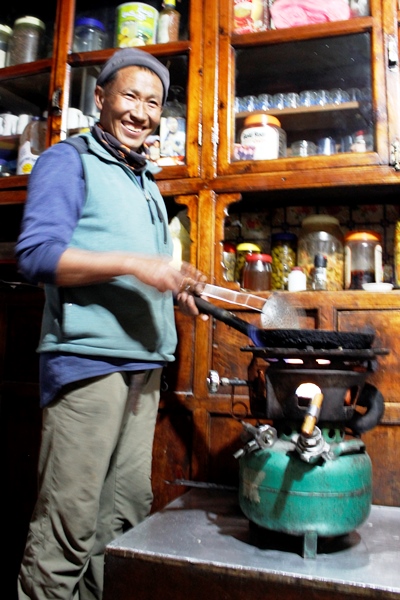
Expect the same meals everywhere. The food did not vary much at all from one teahouse to the next. For breakfast, omelets, porridge and pancakes were typical whereas for lunch and dinner, choices included slight variations of rice, potatoes, pasta and dumplings. Meat was a rarity outside of Namche so most of your protein will come from eggs. For someone who is gluten free as I am, your options will be plain rice, fried rice without soy sauce, fried potatoes, boiled potatoes, French fries, omelets and fried eggs. It gets old, believe me!
Bucket showers aren’t so bad. I was expecting the worst when I heard that most showers in the mountains would be “bucket showers.” I was picturing sitting or standing in a small room with a bucket of hot water and trying to give myself a sponge bath of sorts while wondering how to wash my hair with so little water. Wrong! I took two so-called bucket showers along the way and neither was anything like that. In both cases, they heated up about five gallons of water and put it in a giant plastic container. The container was set on top of the shower “room” and connected to a shower head. So as I turned the shower head on, the water flowed out, feeling much like a “normal” shower. And the teahouse in Pengboche had a regular gas-heated shower which I quickly dubbed “the best shower ever.”
Altitude sickness is serious business. Altitude sickness is not a joke and it can kill you. If you get delayed flying into Lukla, don’t try to skip a day of acclimatization to make up for lost time. We encountered a group who left Namche the same day as we did but made it to the top of Gokyo Ri a full two days earlier. One of the girls was so sick by the time she got to the top that she had to come straight back down. In Tengboche, we saw a woman being evacuated by helicopter and at the porter rescue center in Machermo, we heard stories of porters succumbing to altitude sickness and almost dying. Go slow and don’t be afraid to hold yourself back if you aren’t feeling well.
