
Hi, my name is Katie and I am a guidebook junkie.
I own enough guidebooks to fill the travel section of an airport bookstore. They sit on a shelf in my closet, meticulously arranged in alphabetical order, starting with a Lonely Planet guide to Africa and ending with a Rough Guide to the USA. Some are for places I have never been and don’t even plan to visit any time soon.
When I am planning a trip, I rarely settle for only one – I like to get a variety of opinions, perspectives and suggestions. Buying a new guidebook brings a rush of excitement for me as I start dreaming of my next trip. When my pre-ordered, brand-new Lonely Planet Guide to Central Asia arrived last Wednesday ahead of schedule, it simply made my day. And I have, on occasion, found myself standing in a bookstore, telling myself to step away from the guidebooks. Yes, I may have a problem…

No matter how much people claim that today’s technology will make the traditional guidebook obsolete, I can’t imagine ever going without. I think I have refined the task of reading a guidebook into something of an art. I usually buy a guide not knowing much about the destination – just that something about it has piqued my interest. I start by reading the basics about the history and major attractions. I love visiting places of historical significance or with a good story behind them and I want to get a feel for what the “must see” places are.
Then, I go through city by city, skimming the descriptions of what to see and highlighting the things that jump out to me the most. I follow that by making a list of specific sites to visit or activities to do in each city. This allows me to narrow down which cities I want to visit. On a two-week trip (my max as long as I am gainfully employed), I typically aim for 2-3 cities.
Next, I go back and read about my selected cities in-depth, taking notes on the websites recommended for hotels, guides, transportation and attractions. From there, I set the guidebook aside and hit the internet, visiting recommended websites and doing Google searches for places without a website listed.
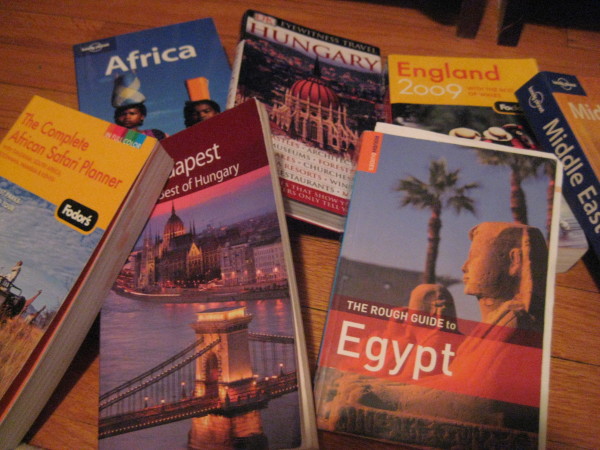
Now, you may be wondering why I don’t just go straight to the internet? Can’t I find everything I need there? True, I probably could, but I like the following aspects of guidebooks:
1. The information is consolidated in one, easy-to-read place. If there’s one downside of the internet, it may be that it has too much information. I find sorting through the results of a Google search either overwhelming (if I search generally) or useless (if I search too specifically). With a guidebook, I can simply skim the table of contents and find what I need. And if I do follow up with online research, I have a much better idea of what I am looking for.
2. Guidebooks give me a level of trust. There’s something about a recommendation from a guidebook that just carries more weight for me over an anonymous poster in the Trip Advisor or Lonely Planet forums. Likewise, there are so many websites out there, it can be hard to know which ones are the most reliable and the most up to date, especially when it comes to less traveled destinations.
3. Believe it or not, guidebooks sometimes include information that isn’t easily found on the internet. This is especially true for more off-the-beaten-path destinations where many of the hotels and guides do not have an internet presence yet. Lonely Planet tends to be the best for this, often listing individual guides and homestays that you likely will not find online (at least not easily).
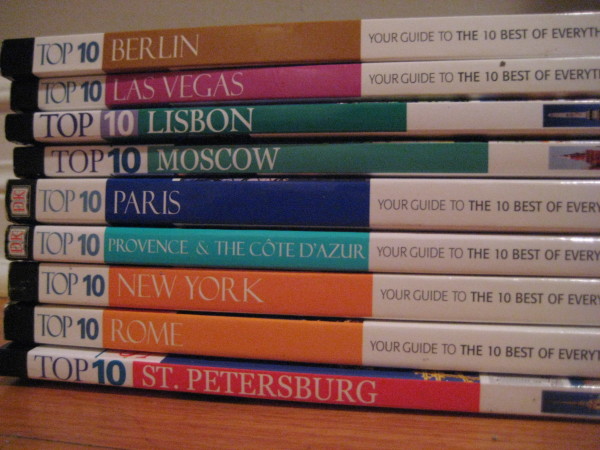
4. I can refer to them along the way. Yes, it isn’t the coolest thing to pull out a guidebook when you are out sightseeing, but I confess I have done so on more than one occasion. Rather than hire a guide at Luxor Temple, I whipped out my Rough Guide and gave a spirited tour to my travel companions. While exploring the Pergamon Museum, I regularly snuck a peak at my DK Eyewitness Top Ten Guide to Berlin to read more about that I was seeing. And when I was stuck in Cologne for an extra day, I led myself on a tour of the 12 Romanesque churches described in my guidebook.
5. They inspire me. Guidebooks often give me unique ideas that I would not easily find on the internet. Most travel and tourist websites focus on the path most taken, while the best guidebooks include some hidden gems. I would never have planned a day trip to Beni Hassan and Tell el Amarna in Middle Egypt had I not read about it in a guidebook. Trier wasn’t on my radar until I read about it in my Frommer’s Germany and now it is one of my favorite places in Germany.
Of course, what it really comes down to is I just like having something tangible in my hands – to highlight, underline, fold corners and flip pages. And I just can’t do that with the internet.
My personal guidebook library grows each week, currently sitting at around 150. I also have the habit of trading books with fellow couchsurfers. It’s a big world, and we should be aware of what is worth exploring! Internet is good for some info, but you can’t ditch the feel of a book just yet.
This posts could have been written by me. I recently had to give away my collection of guidebooks (many of which I haven’t used on site) because I’m emigrating and didn’t want to pay loads of shipping, and…I…actually…cried.
I have changed my mind about guidebooks inspiring trust though. The last few lonely planet guidebooks have been so filled with stupid mistakes that nowadays I wish there was a better alternative, but as you said, the internet is just too much at the moment, and it would take ages to personally find all the info available on guidebooks.
Yeah, I definitely don’t rely on them blindly. If anything, they just give a good starting point. For example, if LP mentions a side trip from a city and the bus to take to get there, at least I know about it and know there should be a bus – and then I ask about it when I am actually in town to confirm the information. 🙂
Katie you’re not alone! I’m also a little bit obsessed with guidebooks too and if I wasn’t currently travelling I’d have many many more!
I think it stems from loving books in general, I just love having some tangible in my hands with beautiful pictures and tips rather than, like you said, trawling the internet (which isn’t always available when you’re lost somewhere!)
ha! love this post. i, too, have a guidebook addiction! trying to find your posts on planning your trip. following you through finland, estonia and russia. enjoy!!
Nothing gets the travel juices flowing like a browse through the travel aisles and my guidebook library. I also tear out pages, make notes, staple print outs to pages, and so forth. There is so much info out there, but I am a total book whore still. I have a Kindle, but I can’t really imagine working through a guidebook the same way I can with a physical book. Long live the printed word!
I equate the purchase of a guidebook with a rock-solid commitment to a journey.
Have book. Will travel.
It’s almost as exciting as the moment your agent (if you use one) hands over your plastic ticket wallet containing documents, bag tags and the like.
And then, there they sit on your shelf for years as a record of the places you’ve been.
I love browsing friends’ bookshelves for this breadcrumb trail of travel experiences.
The perfect conversation starter.
I can relate, I’m a junkie for travel lit, partially because they inspire me to travel, and because they fulfill my need to travel during the times that I can’t afford it. Out off all the guide books I have my LPG to China (same shape and weight as a brick), that I display in my book case in all it’s well worn, water stained, and falling apart glory. It was my bible on my frist trip there, and one of my favourite memories is reading that book on the long train trips between cities. Thanks for writing about guide books, in our even technological world it’s nice to hear a nod to the book!
Omigosh, I love that you’ve kept your guide to China! I do admit, once I’ve taken a trip, if I doubt I’m going back any time soon, I usually sell or give the guide away.
Hi Katie! My boyfriend and I are total guidebook junkies like you are! 🙂 We shelves and shelves heaving with the books. We would never dream of travelling anywhere without at least one guide (usually Lonely Planet or Time Out) and we have guides to places we’ve never been…we just like to read them for fun. Others we have are well-worn and used.
Yay! Love to hear of other addicts like me – especially when everything is going electronic now! I just love having an actual guide to flip through. 🙂
I like to look at guidebooks for ideas on things to do and to plan the overall itinerary but I agree with Natalie that when it comes to specific accommodation, restaurant, bar and culture info I use the internet. I prefer travel blogs, Wikitravel, Trip Advisor and local online magazines when available. Because we find, especially with Lonely Planet, the “LP effect” can completely ruin places. Once they get listed everyone flocks to them and many get lazy. At least that is what we have found this year. Also, the books get outdated very quickly because of the writing to publishing time gap.
Funny enough, I have the opposite opinion on guidebooks. I hate them! Wait until you get on the road and realize that more people carry around the latest Lonely Planet than the bible. LOL! It’s called the travelers bible for a reason.
I will give you one piece of advice. NEVER, and I mean NEVER trust a guidebook (esp. Lonely Planet) when choosing a hostel/guesthouse. Considering every traveler carries around a LP, they usually tend to choose one of the top 3 hostels listed under the current city that they’re in. The problem is that the hostel/guesthouse owners realize they’re getting all this traffic from LP and forget to maintain and put money into their hostels (bedding, sheets, common rooms, etc) because they’re just thinking of the profits that are coming in due to LP. All of a sudden a gem of a hostel becomes a run down, nasty hole in the wall all thanks to LP. I’ve seen this first hand in many places, most importantly Hanoi, Vietnam where I went around checking out the top hostels in LP under Hanoi and I couldn’t believe my eyes. Total dumps!
When it comes to transportation tips, routes from country to country, translations, etc this is where LP can be very handy. Otherwise you can call me an LP and guide book hater. Sorry! 😉
Hi Ryan, thanks for the comment! I should clarify, I try not to rely solely on a guidebook recommendation when it comes to accomodation – I almost always end up checking out reviews online or the LP forums to get some real traveler feedback.
Probably my biggest reasons for loving guidebooks, though, is number 5 – the ideas and inspiration they give me that I might not otherwise find. While some people may argue that guidebooks keep everyone treading the same beaten tourist path, I like to seek out the things in the guidebooks that are a little further off the path. There have been places I’ve visited that I’ve read about in guidebooks where I have literally been the only person there, which is a lovely feeling. 🙂
I can totally relate. I use guidebooks to inspire me, and if I’m ever bored, I just go to the bookstore and browse the travel section. This is exactly how I plan the nitty gritty details of where to go.
But where I think guidebooks are failing in favor of more modern means is while you’re actually traveling. Don’t get me wrong, I love me some Lonely Planet, but that’s a whole lot of weight to lug around with you, especially when the information may not be current. I usually copy chapters to take with me and rely and the internet and fellow travelrs for more in depth details.
Aaron – that’s so true! I often photocopy chapters or even tear out the pages to carry along with me. I do love the DK Eyewitness Top Ten guides, though, for big cities. They are slim enough to easily fit in my purse for the day and provide great info for touring museums or other historical sites.
I can relate. My wife and I have shelves full of them. We all must mutually agree to just get up and go to ALL of these places one day!
Katie, you read guidebooks like I read cookbooks and recipes. With more than 800 cookbooks and the internet, I’m never one to just pick one and go with it. Half the fun is the exploration.
Thank you for another reminder that interests and learning coincide and cross disciplines.
Travel well!
Susan
I can honestly say I can not remember ever buying one guide book. I prefer getting the information from the internet, and them making bullet point notes on what I think I should remember.
I will confess however that I have an addiction to language books. My travels are around Turkey and when ever I see a Turkish language book, I have to buy it.
Between your guide books and my language books, we have probably spent enough on books that would cover a RTW trip!
I’m a guidebook junkie too! I have so many of them. I agree with you – I love being able to write notes in the margins and underline things.
I collect guidebooks too heheh
Hi Rebecca!
Yep, those are all from my collection (but definitely not all of my collection!)
I have pretty good self control when it comes to buying books for no reason, but I can never NOT enter a book store and head straight to the travel section, just to see what the latest books are and whose have been updated (and see if they match my latest travel adventures!)
Love the pictures in the post. Are they from your collection?!
I work at a university and we get 20% off at the bookstore, so I buy a lot of them there. I also wait around for 30-40% off coupons from Borders. 🙂
This is so funny, looks everyone has an addiction to something. My addiction is CDs, but I have cut it cold since Im saving for my RTW trip!
Anyway back to you, i love how you described the process in detail. I love reading guidebooks but not buying them cus they are too expensive. I normally will go to the book store with a note pad. Ill have a seat at the travel section and take notes from the countries I need info on.