
The most fascinating thing for me about visiting Chernobyl was the 90 minute documentary we watched in the van on the way to what is known as the 30 kilometer exclusion zone.
It isn’t that the rest of the day-long visit wasn’t interesting – it certainly was.
But it didn’t feel as eerie or moving or emotional as I expected it would.

I was only nine years old when reactor number four at the Chernobyl power plant not far from Kiev exploded around 1:30 a.m. on April 26, 1986. I probably heard about it on the news when the United States government finally learned about it a couple days later. Perhaps it was mentioned in school, perhaps it wasn’t – I don’t remember.

I honestly don’t recall ever really learning much about the accident or the controversy that followed. And I don’t think I would have even thought of visiting there during my trip to Ukraine if I hadn’t read in one of my guidebooks that tours were available. While a judge temporarily suspended tours last summer due to concerns over where profits were going, they were reinstated shortly before I arrived in Ukraine.
I jumped at the opportunity to learn about it for myself.
The documentary about the accident was surprisingly candid, walking us through the disaster minute-by-minute, hour-by-hour. It fully admitted the efforts made by Soviet officials to cover up the immediate and long-term effects of the blast on the surrounding population. At the same time, it shed light on the issues that faced officials in the days after the explosion – issues that, to this non-scientific ear, sounded eerily similar to those facing Japan in the days after last year’s earthquake and subsequent meltdown at the Fukushima power plant.

Our visit began in the 30 kilometer exclusion zone, which includes the actual town of Chernobyl. People still live there, including our tour guide, Vita. However, due to lingering radiation levels, strict controls exist. No children may live in the zone and those who work in the zone follow “half-on, half-off” schedules. For example, Vita works for fifteen days, during which time she lives in the zone, and then has fifteen days off, during which time she lives in Kiev.
There, we stopped at Chernobyl’s only hotel, where Vita showed us maps of the area and explained where we were going and what we would see throughout the day.

In the center of Chernobyl town stands a memorial in the form of an angel blowing a horn. It refers to the following passage of the Bible which describes the end of days, signaled by seven angels blowing seven horns:
And the third angel sounded, and there fell a great star from heaven, burning as it were a lamp, and it fell upon the third part of the rivers, and upon the fountains of waters; And the name of the star is called Wormwood: and the third part of the waters became wormwood; and many men died of the waters, because they were made bitter. (Revelation 8:10-11)
Chernobyl is the Ukrainian word for “wormwood” and thus some believe that the Bible actually predicted the disaster at the power plant and subsequent contamination (including the nearby rivers).

On our way out of town, we stopped to see some of the military vehicles used in the immediate aftermath of the accident. Although they were thoroughly cleaned multiple times and although nearly twenty-six years have passed, when Vita held a Geiger counter up to the wheel, it still registered higher than normal levels of radiation.

Our next stop was a kindergarten in a village on the way to Pripyat, the town closest to the power plant. I was surprised at the state of the small school, expecting it to look like it did when it was abandoned, like a place frozen in time. Much to the contrary, it looked like a bomb had exploded in the building, with cracked windows, papers strewn across the floors, and broken chairs and beds scattered throughout (note that the date on the newspaper below is five years after the accident).


The same was true when we visited the “ghost town” of Pripyat itself – the first town to evacuate after the accident. Sure, there were reminders that no one had occupied the town since 1986, like a record sitting in a classroom, a child’s report card dated for the 1985-1986 school year and piles of gas masks on the floor of a school cafeteria – those were commonplace precautions in case a nuclear war with the United States began. But I felt more like I was walking through the aftermath of a tornado rather than an abandoned building frozen in time.


Perhaps the biggest reminder that Pripyat is nothing but a ghost town today was the fact that several feet of snow from the previous weeks remained almost completed untouched. Trudging through drifts several feet high, our footprints were often the first anywhere in sight. As we tried to reach the abandoned school, Vita and our driver had to clear snow of the tree branches in front of us (side note: I got slightly distracted by the fact that Vita and the driver were flirting with each other throughout the day; it was really cute).

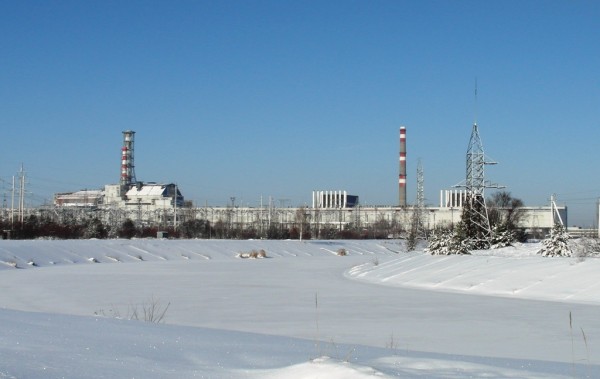
Seeing reactor number four was a bit of a letdown. Perhaps naively, I was unaware that the actual reactor isn’t visible – it is covered in a massive steel and cement structure called the “sarcophagus.” This was built to contain the radiation escaping from the reactor in the months after the accident. So from the outside, the site of this massive disaster looks like much like any other power plant.

In the end, the things I took with me from the visit had little to do with what I saw and everything to do with what I heard.
I sympathized with the government officials who struggled with how to handle the accident. There was no “how-to” guide in place telling them how to contain the massive fire in reactor number four or how to prevent further explosions from taking place. It also took time for people on the ground to convey information to those making the decisions. This was 1986. There were no mobile phones or wireless internet. Technology in general was not as advanced as it is now. Things took time.
Many may say that Soviet officials were too slow to react, but consider this:
As soon as they realized the high radiation levels in Pripyat, they made the decision to evacuate – less than 24 hours after the accident. The following day, they brought in buses and emptied the entire town of 50,000 people in a matter of three hours.
Three hours.
Can you imagine that happening in the United States today? I can’t.
Say what you want about the communist system, but the fact that people were immediately inclined to follow government orders likely saved lives.

My heart broke for the immediate responders – the plant workers who lost their lives within days after exposing themselves to lethal doses of radiation as they stayed at the plant trying to contain the situation. They did their jobs in nearly impossible circumstances, working around the clock and without protective gear.
And I ached for the workers summoned from throughout the Soviet Union in the days and weeks after the accident to aid in the clean-up at Chernobyl.
The firefighters who responded within hours to extinguish the blaze.
The military personnel who cleared away radioactive debris in forty-second shifts to minimize exposure to radiation.
The 250,000 construction workers who built the massive coffin of steel and cement to seal off the reactor, all of whom reached their lifetime limits of radiation exposure in the process.

But more than anything, the thing that chilled me the most and brought a tear to my eye was listening to the narrator of the documentary describe the efforts of hundreds of mine workers to dig a tunnel to install a cooling system underneath the reactor to prevent a further explosion – an explosion that could have been even larger than the first and that could have effectively wiped out part of Europe.
It could have been so much worse.
