
While losing your passport on the road is probably a traveler’s worst nightmare, I would guess most would agree a lost ATM card is a close second.
I experienced that sinking feeling last week.
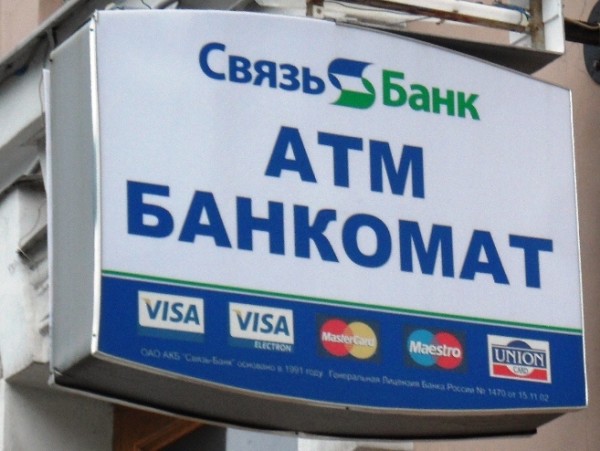
I nonchalantly inserted my Capital One debit card into a Russian bank’s ATM machine in the center of St. Petersburg and it never came back out.
As soon as the message flashed on the screen that the machine was keeping my card, tears started to fill my eyes (yes, I cry easily!), but instead of losing it in the middle of a bank lobby, I sprang into action. Two security guards sat in a vestibule across from the ATM machine and another woman was hanging around who seemed to work there, although I never figure out what she did.
Using broken Russian, I managed to explain to all three of them what happened and they quickly offered their help. One of the guards called someone with the bank while the woman fended off people who tried to use the ATM in the meantime. She offered me a seat and rambled on and on to me in Russian. Even though I only understood about 10% of what she said, it felt reassuring.
The security guard was able connect me with a bank representative who spoke a small amount of English (I actually think he tried to translate phrases to recite to me every time he put me on hold for minutes at a time). By the end of the call, I understood that the bank would empty the ATM on Friday (this was Wednesday) and I had a phone number to call Friday morning to speak to someone about getting my lost ATM card back. The bank representative also took my name and my phone number in St. Petersburg.
Then I had to wait.
I am not good at waiting.
So between Wednesday afternoon and Friday morning, I started exploring backup options in case I could not get my card back. I spoke with Capital One and, while they confirmed my card was still active, they could not send me a replacement card internationally. They could send one to my parents in about 10 days, so Plan B was to have my parents then send me the replacement card by FedEx in Moscow.
Plan B quickly disintegrated when I learned that Russia prohibits the “import” of plastic cards of any kind, including credit and debit cards.
That led me to Plan C, which would be for my parents send me the card in mid-December when I get to Lithuania.
While I was hoping I would not have to resort to Plan C, I felt just so slightly better having a plan in place. Remember, I am the queen of planning.
Friday morning arrived and, while I speak some Russian, I was not at all confident that I could handle the situation myself. So Alla, a staff member at my hostel, called for me. I listened patiently, catching bits and pieces of the conversation until it ended with her hanging up, shaking her head and saying the Russian word for “bad.” She explained that the bank told her that they would not empty the ATM until the following Friday, by which time I would be long gone from St. Petersburg.
Luckily, when Irina, the hostel’s administrator, arrived an hour later, she would not take that for an answer and called the bank again. She pleaded my case with great force, even arguing that giving me my card back would be good for Russian-American relations (I got a good laugh at that but she seemed to think it made the difference). By the end of the call, they told her they would empty the ATM machine that day and return my card as soon as they received a fax from Capital One giving them permission to do so.
My initial reaction? Yeah, right. Not gonna happen.
Because of the time difference (St. Petersburg is eight hours ahead of the East Coast), I had to wait until 3:00 p.m. to call Capital One. I also sent messages to their Twitter account, trying every avenue possible to reach someone who could help.
After being transferred around a couple times, the first Capital One representative I reached was skeptical that the Russian bank could return my card to me at all, saying that they typically just shred them. However, I once saw a friend get her ATM card fished out of a machine in Egypt and multiple people shared stories on Facebook about getting cards back, so I knew it was feasible. Nonetheless, the woman put me on hold to try to locate an account supervisor to discuss the fax request. After thirty minutes on hold, I almost lost it when someone finally got on the line only for me to lose my Skype connection.
Ten minutes later, I was back on the phone with another representative who proceeded to tell me that Capital One cannot issue “ad hoc” letters like the one the Russian bank was requesting. I begged and pleaded with him (as nicely as possible of course) to connect me with someone who might have the authority to come to a different conclusion, but he refused, saying he already talked with his supervisor and there wasn’t anyone higher to which to appeal.
I hung up the Skype call with tears in my eyes and went out to the common area of the hostel to tell Irina the bad news.
She just smiled and said “no, no, don’t worry, your card is here.”
I didn’t know whether to laugh or cry. I went from feeling completely hopeless to ecstatic in about thirty seconds. I mistakenly thought she meant someone was actually at the hostel with my card, so I started running all over the hostel to find my shoes and my passport, afraid that they might leave if I didn’t hurry. Irina laughed at my craziness and told me to slow down, that the card was at the bank branch on Nevsky Prospekt, a few blocks away. And then I took off running around anyway.
Five minutes later, I walked up the marble staircase of the bank building and through a large wooden door. Turning to the receptionist by the entrance, I introduced myself in Russian, giving her my name and saying I was an American and that they had my ATM card. Before I could even finish, I saw my card sitting on the desk in front of her with a piece of paper attached to it. She held it up and showed it to me and a huge smile came across my face. I almost started crying again, this time tears of happiness.
The receptionist handed me the form and asked to see my passport. The form was basically the same as what they had requested Capital One to send to them, but instead of Capital One giving them permission to return my card to me, I was giving them permission to return my card to me. With my hand shaking, I carefully filled in my name and passport number and then waited for her to make a copy of my passport and visa. And then I said a very, very big thank you and walked out of the door with my card in hand.
So what did I learn from this experience?
- First, always have a backup ATM card when you travel. I had a backup, which made things easier (I was able to withdraw cash in the meantime). But considering I have close to ten months left on the road, I did not like the idea of having only one card for the rest of my trip.
- Second, whenever possible, try to use ATMs located in the lobbies of the banks that own them. Because I lost my card in the bank lobby, there were people readily available to help me. If I had lost my card in a random ATM in a metro station or on the side of a building, it may have been much more difficult. I think this is also a good idea for security reasons – when you withdraw money inside, fewer people are around to see it and potentially target you for pickpocketing.
- Third, if you do lose your ATM card in a machine, enlist the help of a local to contact the bank to get it back. Even if I was fluent in Russian, I think Irina was persuasive in a way that I could never be.
- Finally, before you leave the country, do your homework. Make sure you are familiar both with your bank’s policies about sending replacement cards overseas and the rules of the country or countries you are visiting about importing cards. It never would have occurred to me that it might be prohibited to send a card into a particular country (and I am guessing Russia is unique in this, but it is worth checking). Furthermore, because Capital One tends to market itself to international travelers by offering no foreign currency transaction fees and no ATM fees worldwide, I mistakenly assumed they would be helpful if anything happened while I was abroad. On the contrary, a Russian bank did more to help me as a non-customer and a foreigner than my own bank did to help someone who holds three accounts with them. I know someone who may be changing banks when she gets home…
