
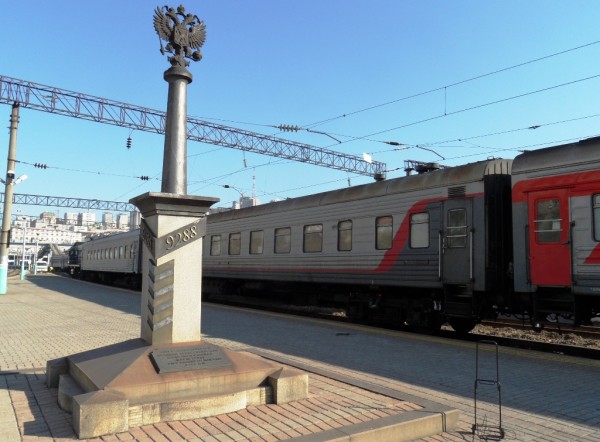
Crossing Russia on the Trans Siberian Railway is on many traveler’s bucket lists. I flew to Vladivostok and spent a month taking the train all the way back to Moscow, making multiple stops along the way. I had read a lot about traveling the Trans Siberian Railway before I began the journey, but there was plenty of information that ended up being inaccurate and dozens of other little things that I wish I would have known.
For those thinking of making this journey, here are some things to consider:
Which route to take?
The traditional Trans Siberian route stretches 9288 kilometers between Moscow and Vladivostok (contrary to what some may say, it does not technically stretch on to St. Petersburg). However, two variations are becoming increasingly popular – the Trans Mongolian, which runs between Moscow and Beijing via Mongolia, and the Trans Manchurian, also running between Moscow and Beijing, but bypassing Mongolia.
Most travelers start their journeys in Moscow and go east, although it is certainly possible (and perhaps more interesting) to go in the opposite direction as I did. If you are keen on interacting with locals and practicing your Russian skills, consider starting in Vladivostok or Beijing and heading west. You will likely encounter fewer tourists (if any) and more locals who are simply taking the train as a means of transportation, not as an adventure.
Where to stop along the way?
Unless you love the idea of spending a week straight on a train, I recommend making at least one stop along the way, if not more. In my opinion, one of the best things about the Trans-Siberian is the opportunity it affords you to see more of Russia than just Moscow and/or St. Petersburg. If you have the time, I would suggest at least two or three stops.
Some possible options include:
- Nizhny Novgorod. Sitting on the banks of the Volga River, Nizhny features a 13th century monastery, 16th century kremlin, several churches and a variety of museums to make it a worthwhile first stop after departing Moscow. River tours on the Volga are also possible in the summer months.
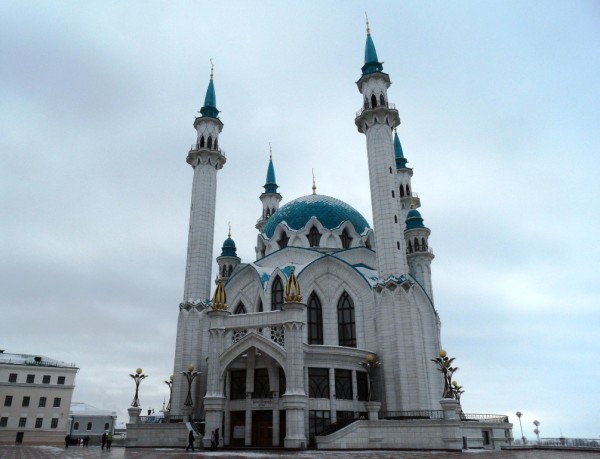
- Kazan. Technically a detour from the main Trans Siberian route, this 1000-year-old city is the capital of the Republic of Tatarstan and one of the most attractive cities you might visit on your journey. Its Kremlin is a UNESCO World Heritage site and just outside of town is the unique Temple of All Religions, a building combining 16 world religions. If you are visiting in June, don’t miss the celebration of Sabantuy, the most popular folk holiday in Tatarstan.
- Yekaterinburg. Stop here to visit the site where Nicholas II, the last tsar of Russia, and his family were murdered in 1918. An easy day trip can also take you to Ganina Yama, the site where their bodies were discarded into a mine shaft. Now considered holy ground by the Russian Orthodox Church, seven chapels have been constructed on the site, one for each member of the royal family.
- Krasnoyarsk. Spend a day just outside of the city hiking in the Stolby Nature Reserve or in the winter, hit the slopes at the nearby ski resort. If you have a week or more to stop and really want to get off the beaten path, Krasnoyarsk is also a great starting point to explore the Khakassia and Tuva regions, known for shamans and throat singing.
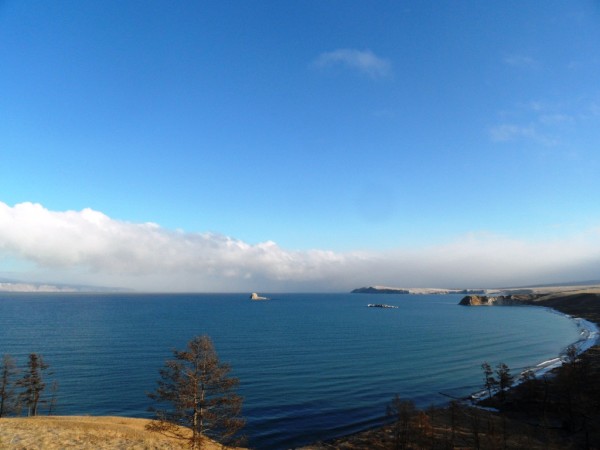
- Irkutsk. The main attraction here is Lake Baikal – the deepest lake in the world. Irkutsk is not actually on the shores of the lake so a stop for at least two days is ideal to allow time for either a day trip to the town of Listvyanka on the lakeshore or a longer trip to Olkhon Island, the largest island in the lake. A minimum of three days is best for Olkhon – a day to get there, a day to explore the island, and a day to return.
- Ulan Ude. Just an eight hour train ride from Irkutsk and not far from the Mongolia border, Ulan Ude is the capital of Buryatia, home to Russia’s largest indigenous people, the Buryats. It is also a center of Buddhism in Russia and if you stop here, a trip outside the city to the Ivolginsky Datsan (Buddhist monastery) is a must. For a different approach to visiting Lake Baikal, you might also plan a few days for a side trip up to the village of Ust-Barguzin on the lake’s southern shore.
- Khabarovsk. Just 19 miles from the Chinese border, Khabarovsk has an international feel to it – more so than most other Russian cities. A stop here may be a highlight for avid museum goers, with options including Far Eastern art, regional history and military museums, as well as city, railway and geological museums. And if you are braving the Trans Siberian in January, Khabarovsk’s annual ice sculpture festival shouldn’t be missed.
Wherever you stop, I recommend trying to arrive in the morning or early afternoon and departing the following night at the earliest. This gives you time to get a feel for the city after you arrive and freshen up and allows a full day to explore more in-depth or arrange for a day trip outside of the city.
Hostels have just started to appear in Siberia over the last few years, although they tend to be no more than a room or two of bunk beds in someone’s flat. However, they provide the essentials after a night or more on the train: a hot shower, washing machine, wi-fi and kitchen facilities. Prices run about $15-$20 per night. Try to book in advance and inform the hostel of when you plan to arrive as many do not keep staff on-site. If you are interested in staying with a Russian family, many local tour companies can arrange homestays – prices range from $30 to $60 per night with meals included.
Booking Your Tickets
When to book?
If you are on a tight schedule, it makes sense to book your tickets in advance. Tickets can be issued up to 45 days in advance and many travel agencies can do this for you. I used Real Russia and highly recommend them – they can also help with obtaining a letter of invitation for visa purposes. You will get an electronic ticket for each leg of your trip, which you then take to the station with your passport and exchange for the actual ticket. It is also possible to book online yourself at www.rzd.ru or www.poezda.net if you can read a little Russian (Google Translate can help!).
Note that the timetables provided on the Russian Railways websites are shown on Moscow time, while the timetables on Real Russia’s website are on local time.
For the more flexible travelers, you can purchase your tickets at the stations as you go along. However, be prepared for the possibility that the train you want may already be sold out and don’t be surprised if none of the cashiers speak any English. And again, schedules posted at the stations generally will be on Moscow, not local time.
Which type of train?
Russian trains vary in speed and quality – the lower the number of the train, generally the higher the standard of service and faster speed of the train. Standard passenger trains are indicated by 3-digit numbers and are slower (40-50 km/hour) with quality that may range from poor to good. Firmenny trains, on the other hand, provide newer cabins, better toilets, restaurant cars and nice digital signs at the end of each car with the current time, temperature and whether the toilet is free. “Fast” trains travel faster than the standard passenger train, but if they are not also firmenny the quality of the train may vary. I traveled on all three types during my trip and while the differences were noticeable, I didn’t feel they were significant.
Which class?
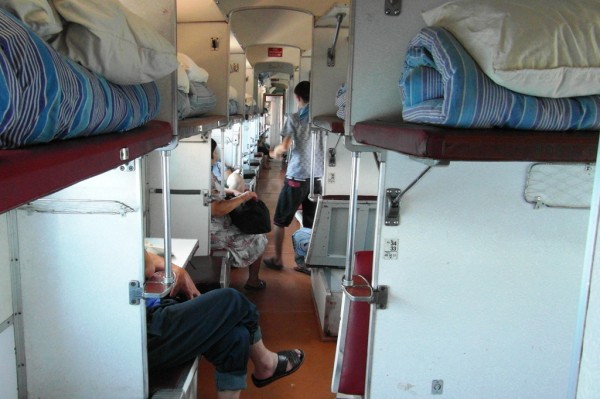
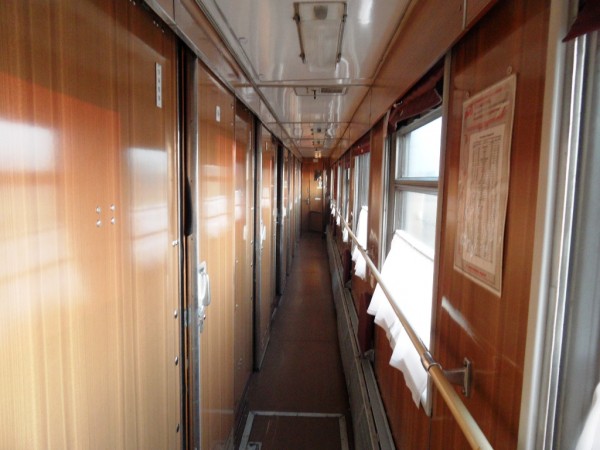
Most trains offer three classes of sleeper service – spalny vagon (1st class), kupe (2nd class) and platskartny (3rd class). Spalny vagon compartments have just two berths, with both beds at the lower level. Kupe are 4-berth compartments consisting of two upper and two lower bunks. Finally, platskartny are open 6-berth compartments with both upper and lower bunks. Both spalny vagon and kupe have doors that lock, while platskartny compartments are open – this makes third class a little more social, but a little less secure. Note that there are rumors that platskartny may be eliminated in the future.
Upper or lower bunk?
If you book early enough, you should be able to select an upper or lower bunk (lower bunks are odd-numbered). If you have a lower bunk in kupe, you’ll have a bin under your bunk where you can store your luggage. My 55L backpack fit just perfectly – anything larger (or any type of suitcase) may have been tough. For the upper bunks, storage spaces are located adjacent to the bunks, extending over the hallways. It may be a bit of a hassle to get a big pack up there, but once it’s there, it’s pretty secure. Keep in mind that during the day, people from the upper bunks tend to hang out on the lower bunks. This can be great if you are looking to socialize or annoying if you’d prefer to stretch out and read a book or sleep.
Single sex compartments?
Many trains now offer single sex compartments, so if you are a single female traveling alone, this may be something you want to consider. I never bothered and while I typically shared my kupe compartment with at least one other male, I never felt uncomfortable (although on one occasion I did get really annoyed with two elderly men who just kept rambling on to me in Russian when I really just wanted to sleep).
What to pack
- Food: while you can buy snacks and drinks along the way in the dining car, from vendors roaming the hallways or from kiosks at station stops, you will likely save money and enjoy a better selection if you bring your own. Good options include dried fruit, nuts, sandwiches, crackers, chips and instant noodles or instant oatmeal (to be prepared with boiling water available from the samovars in each carriage).
- Comfortable clothing: shorts, sweatpants, tank tops and various forms of pajamas are all common. If you are traveling in the winter months, be prepared for it to be surprisingly hot. Most of my trains departed in the evening and people often changed clothes as soon as we left the station.
- Slippers or flip-flops/thongs: much easier to slip on than your shoes or boots each time you want to roam the halls.
- Toiletries: soap, toothbrush & toothpaste, baby wipes, deodorant. It’s also a good idea to bring some extra toilet paper. I found the toilets to generally be well-stocked, but every now and then they ran out.
- Entertainment: books, a Kindle, playing cards or anything else to keep you entertained for hours on end, especially if your bunkmates are less than sociable.
- Dishes: depending on the type of train and class of service, these may not be necessary, but it may be a good idea to bring your own coffee mug for tea/coffee and your own bowl and spoon for preparing noodles or oatmeal.
Most importantly, try to pack light as luggage space is limited. If you are carrying a large pack, put everything you need for the train in a separate bag so you can easily access it throughout the journey.

What to expect on the train
Time: The trains run on Moscow time, so that is what you will see on your ticket and on the schedules posted on the train and in the stations. If you are on a nicer, more modern train, there may be a digital display at the end of the hallway showing the time; otherwise, don’t count on seeing a clock anywhere on the train.
Boarding: You will show your ticket and passport to the attendant before boarding and she will come by your compartment to check your ticket again once the train has departed, making note of your destination. If you are scheduled to disembark in the middle of the night, the attendant will likely wake you up (but I would set an alarm to be on the safe side).
Bedding: Pillows, sheets and blankets, as well as a hand towel, are provided.
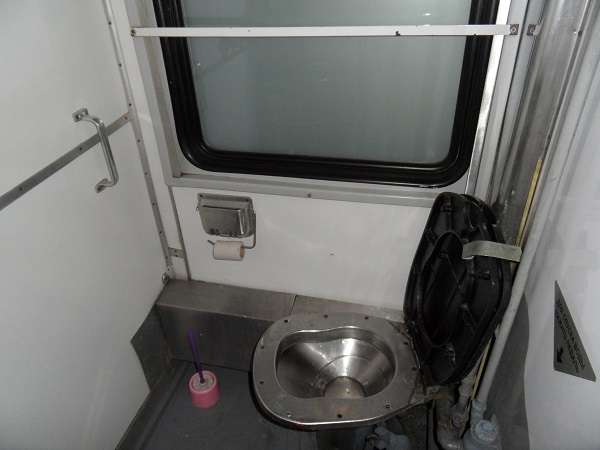
Toilets: Each carriage has a toilet on each end and they will be locked for up to 30 minutes before, during and up to 30 minutes after most station stops (and border crossings if you’re heading into China or Mongolia). The toilet doors usually have a schedule showing these closures.
Water: You will find a samovar with boiling water on one end of the car, usually opposite the attendant’s compartment. If you bring your own water bottle, you can also refill it with drinkable water from the attendant.
Cleanliness: Trains are generally kept quite clean, with floors being swept at least once a day and toilets cleaned regularly. Garbage bins are usually located opposite the toilets on one end of the carriage.
Electronics: Outlets for charging cell phones and the like are available in the hallways. Most carriages have fold-down seats so you can sit with your device as it charges, although it was not uncommon for people to leave theirs hanging unattended.
Internet: The trains are not equipped with wi-fi (at least they weren’t when I made the journey in late 2011), but if you have a Kindle with free 3G or a phone with data, you should be able to access the internet when the train is stopped at most towns. If you purchased a cell phone or SIM card in Moscow or St. Petersburg, it may or may not work once you are on the train; my Moscow SIM card did not have coverage outside of Moscow and I didn’t learn that until it was too late.
People: Your experience will likely vary based on a variety of factors: what time of year you travel, which direction, what type of train you are on and whether you are in spalny vagon, kupe or platskartny. Heading west to east throughout the month of November, I felt like I was the only tourist on board and certainly the only English-speaker. I shared my kupe compartment with a grandmother and granddaughter, an orphanage teacher, a university student, members of a girls’ volleyball team, a few businessmen/women, a couple military men and an engineer who was anxious to practice his English with me. If you begin in Moscow and travel during the summer or early fall, you are more likely to encounter other tourists. If you are looking for the most social experience possible, consider giving up some privacy and comfort for the more open atmosphere of platskartny.
Have you traveled on the Trans Siberian? What advice would you add?
