

When an earthquake strikes, it can garner a lot of attention in the days and weeks that follow. I can clearly remember being glued to my television set watching the aftermath of the earthquake in Japan a couple years ago and the tsunami that followed.
But what happens in the years that follow the earthquake?
What happens once the rest of the world stops paying attention and the city and people affected by the quake have to recover and rebuild?
I asked myself this as I visited Gyumri, the second largest city in Armenia. You probably haven’t heard of Gyumri. And you probably don’t recall that it was hit by a massive earthquake back in 1988. I certainly didn’t.
But before I get to the earthquake, a little about Gyumri.
The region around Gyumri is thought to be the oldest in Armenia, with excavations in the old part of the city revealing a settlement dating all the way back to 3000 B.C. More recently, Gyumri was the site of a Russian military outpost in the early 19th century, when Tsar Nicholas I visited and renamed the city Alexandropol in honor of his wife, Alexandra. It served as an important trading post between the Ottoman Empire and the rest of Asia and was once the third largest city in the Caucasus after Tbilisi, Georgia and Baku, Azerbaijan.
And then December 7, 1988 happened.
It was “only” a magnitude 6.8 quake, but the damage was devastating. Over 50,000 people died and thousands more were left homeless. The recovery cost was estimated to be greater than the cleanup after Chernobyl.
If that wasn’t enough, just three years later, the Soviet Union collapsed, leaving Armenia a newly independent country – and a country at war with neighboring Azerbaijan.
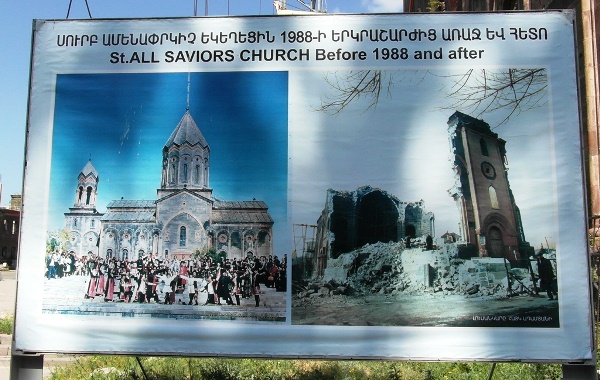
Just off Gyumri’s main square stands a lasting reminder of the earthquake’s damage: the St. All Saviors Church, which is still under restoration. A small billboard in front of the church shows before and after pictures.

Across the square stands the Yot Verk Cathedral which was not as heavily damaged and already completely restored.
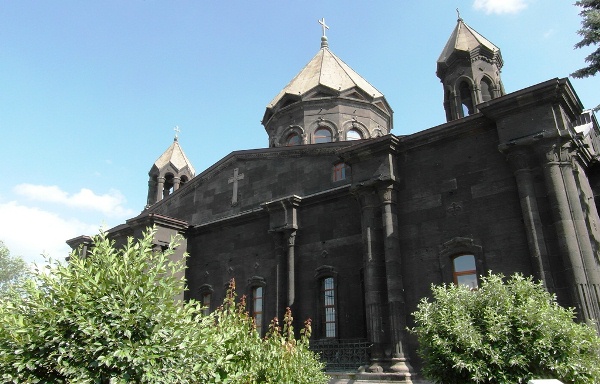
And several blocks from the main square stands the 19th century St. Gregory the Illuminator Church whose dome caved in during the earthquake. I walked by a couple times without even realizing a church once stood there – as a neighborhood church that served the working class population, the church still awaits renovation.
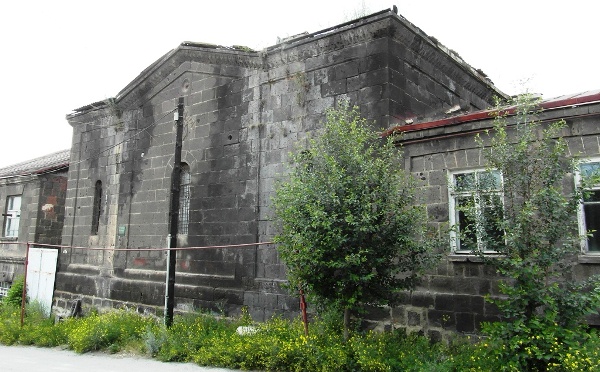
Walking around the old part of town, I passed numerous buildings that still lay partially in ruins, either awaiting or currently undergoing renovation – 24 years after the earthquake.


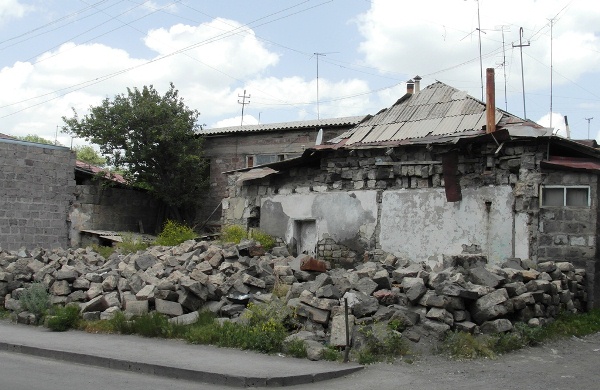
And when I saw piles of rubble like this, I couldn’t help but wonder if they were remnants of the earthquake as well.
Heading out of town, a friend pointed out shacks that were originally intended as temporary housing, but that people still lived in as recently as a few years ago. And on the outskirts of Gyumri stand multiple apartment buildings, begun in the years following the earthquake but never completed when Armenia’s economy struggled in the post-Soviet years.

But then there are the buildings that survived. The 18th and 19th century buildings in the historic Kumayri district of Gyumri that amazingly made it through earthquakes in both 1926 and 1988. The buildings made of black and red tufa that make the architecture in Gyumri (and elsewhere in Armenia) so interesting and unique.


While I have sometimes described cities as being “a mix of old and new,” Gyumri presents an eclectic mix of old and older – a combination of damaged, destroyed, renovated and under construction. The city hasn’t fully recovered from the 1988 earthquake, but it hasn’t given up either – it is still fighting to spring back to life.
It isn’t always pretty, but it is full of charm and character.
Have you ever visited a city that’s been severely damaged by an earthquake or other natural disaster?
